
- English
- Español
- Português
- русский
- Français
- 日本語
- Deutsch
- tiếng Việt
- Italiano
- Nederlands
- ภาษาไทย
- Polski
- 한국어
- Svenska
- magyar
- Malay
- বাংলা ভাষার
- Dansk
- Suomi
- हिन्दी
- Pilipino
- Türkçe
- Gaeilge
- العربية
- Indonesia
- Norsk
- تمل
- český
- ελληνικά
- український
- Javanese
- فارسی
- தமிழ்
- తెలుగు
- नेपाली
- Burmese
- български
- ລາວ
- Latine
- Қазақша
- Euskal
- Azərbaycan
- Slovenský jazyk
- Македонски
- Lietuvos
- Eesti Keel
- Română
- Slovenski
- मराठी
- Srpski језик

Can Stainless Steel Deep Drawn Housings Replace Aluminum in Medical Devices?
For decades, aluminum has been the default material for medical device housings – lightweight, easy to machine, and moderately corrosion‑resistant. But today’s surgical tools, implantable drivers, and diagnostic instruments face harsher demands: repeated autoclave sterilization, aggressive chemical cleaning, and ever‑shrinking form factors. Engineers are asking: can stainless steel deep drawn housings step in? The answer is increasingly yes. Thanks to advances in precision stamping and deep drawing, stainless steel housings now match or exceed aluminum in weight (via thinner walls) while offering superior durability, EMI shielding, and sterilisation compatibility. This article explores the trade‑offs, the technical breakthroughs, and why medical device manufacturers are re‑evaluating their material choices.
Where Aluminum Falls Short
Aluminum is not perfect for every medical application. Common pain points include:
- Corrosion under autoclave – Steam sterilization at 134°C causes pitting and surface oxidation, especially on scratched anodised layers.
- Softness – Aluminum dents easily during handling or assembly, compromising hermetic seals.
- Limited thread strength – Screw threads strip in thin‑walled sections.
- EMI vulnerability – Aluminum provides decent shielding but less than stainless steel for high‑frequency interference (critical for MRI‑adjacent devices).
For single‑use or limited‑reuse devices, aluminum remains cost‑effective. But for reusable surgical instruments and long‑life implantable drivers, stainless steel deep drawn housings are gaining ground.
Why Stainless Steel Deep Drawn Housings Now Work
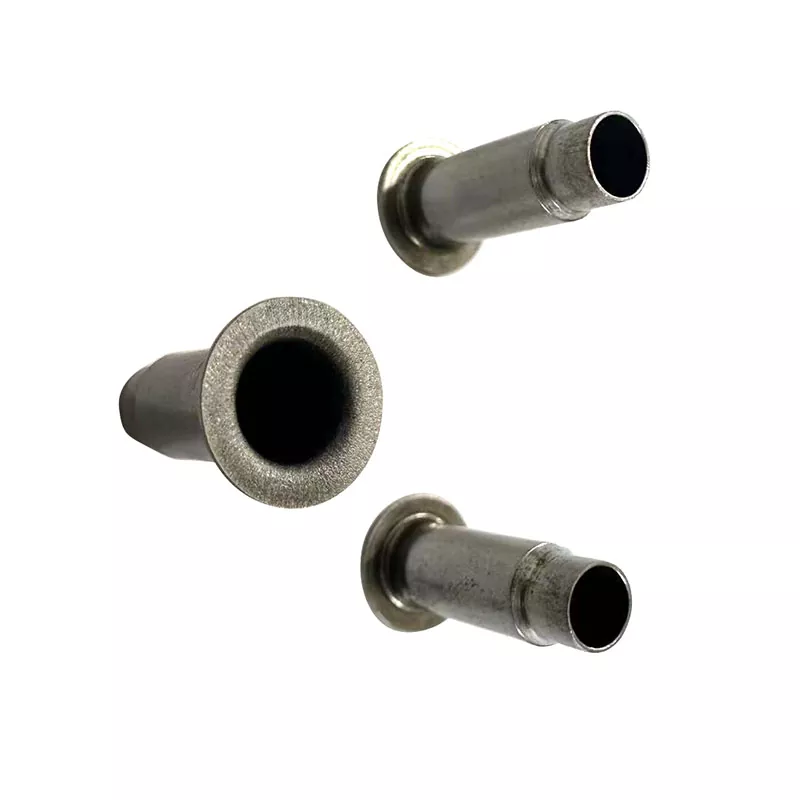
Deep drawing is a sheet metal forming process where a flat blank is radially drawn into a die cavity to create seamless, cup‑like shapes. Historically, stainless steel (especially 304 and 316L) was difficult to deep draw due to work hardening and springback. Modern solutions include:
- Multi‑stage deep drawing presses – Up to 10 stations gradually form the metal without tearing.
- Intermediate annealing – Laser or vacuum annealing restores ductility between stages.
- High‑press lubricants – Specially formulated for medical‑grade cleanliness.
A leading manufacturer, Xiamen Lijingda Precision Stamping Co., Ltd. (founded 2004), has mastered these techniques. Their 25 precision presses (25–500 tons) and Japanese slow wire cutting machines produce deep drawn housings with wall thicknesses as low as 0.3mm – achieving stainless steel housings that are only 15–20% heavier than equivalent aluminum designs, yet with triple the yield strength.
Parameter Comparison – Stainless Steel vs. Aluminum Deep Drawn Housings
| Parameter | Aluminum (6061‑T6) | Stainless Steel (304 or 316L) – Deep Drawn |
|---|---|---|
| Density (g/cm³) | 2.70 | 7.93 (2.9× heavier) |
| Wall thickness achievable (mm) | 0.8 – 2.0 | 0.3 – 1.2 (with multi‑step drawing) |
| Final weight for equivalent stiffness | Baseline (1×) | ~1.2× (thinner walls compensate) |
| Yield strength (MPa) | 240 – 280 | 700 – 1000 (cold‑worked) |
| Surface hardness (HV) | 30 – 40 (anodised: 300‑400) | 180 – 230 (work‑hardened) |
| Autoclave resistance (134°C) | Pitting after 100 cycles | No visible change after 1000 cycles |
| Chemical resistance (bleach, alcohol) | Moderate; anodising degrades | Excellent (passive layer self‑repairs) |
| EMI shielding effectiveness (dB) | 80 – 100 | 110 – 140 (better at high frequencies) |
| Relative material cost | 1× | 1.3 – 1.5× |
| Tooling life (deep draw dies) | 500k – 1M parts | 200k – 400k parts (wear faster) |
Where Stainless Steel Deep Drawn Housings Excel in Medical Use
1. Reusable Surgical Tools
Handpieces for electrosurgery, endoscopes, and powered bone drills. The housing must survive hundreds of steam cycles without corrosion or seal failure. Stainless steel deep drawn housings create seamless, crevice‑free surfaces that do not trap bacteria.
2. Implantable Device Drivers
External controllers for pacemakers or neurostimulators are carried by patients for years. Dropping an aluminum device can dent it, breaking internal PCB mounts. Stainless steel housings absorb impact without permanent deformation.
3. MRI‑Compatible Equipment
While both are non‑magnetic (304/316L are austenitic), stainless steel provides better shielding against RF interference, reducing artefacts on MRI images.
4. Portable Diagnostic Instruments
Handheld blood analysers and ultrasound probes. The higher dent resistance means field‑reliable operation even after accidental drops.
Overcoming the Weight Objection – How Precision Deep Drawing Helps
The main argument against stainless steel deep drawn housings has been weight. A solid stainless steel box is heavy. But deep drawing allows thinner walls. For a typical 50mm × 30mm × 10mm housing:
- Aluminum (1.0mm wall) → ~27g
- Stainless steel (0.4mm wall) → ~34g
The stainless part is only 26% heavier, not 190% as raw density suggests. And the stainless housing is significantly stronger, allowing ribless designs that simplify cleaning.
Xiamen Lijingda Precision Stamping Co., Ltd. specialises in such thin‑wall deep drawn housings. Their 500‑ton presses, combined with PG optical grinding for die precision, achieve wall thickness tolerances of ±0.02mm – critical for gasket seals in waterproof medical devices.
When to Switch to Stainless Steel
Consider stainless steel deep drawn housings if:
- Your device requires >500 autoclave cycles.
- The housing is often dropped or knocked (surgical suites, field clinics).
- You need superior EMI/RFI shielding (near MRI, radio‑frequency ablation).
- Chemical disinfectants corrode your current aluminum finish.
- You want a seamless, bacteria‑proof interior surface.
Stick with aluminum if:
- The device is single‑use or limited‑use (<50 cycles).
- Weight is absolutely critical (e.g., miniature implantable driver with <10g budget).
- Production volume exceeds 500k/year and tooling wear becomes a cost issue.
What to Demand from a Deep Drawing Supplier
Not all stamping shops can produce medical‑grade stainless steel deep drawn housings. Look for:
- Precision equipment – Japanese slow wire EDM and PG optical grinders for die making (Xiamen Lijingda has 6 slow wire cutters and PG grinders).
- In‑process cleaning – Hydrocarbon ultrasonic cleaning lines to remove drawing lubricants (medical cleanliness requires <1mg residue per part).
- Testing instruments – At least 10 precision testers for CMM, surface finish, and leak detection.
- Certifications – CE/UL for any integrated sockets or electrical features (Xiamen Lijingda’s own brand siooan industrial socket has CE/UL).
- Experience – Over 15 years in precision stamping for automotive, rail, and electronics – a strong proxy for medical reliability.
Xiamen Lijingda Precision Stamping Co., Ltd. (and its 2014 sister company) serves aerospace, new energy automotive, and medical sectors. Their R&D team routinely works on deep drawn housings down to 0.3mm wall thickness in 304 and 316L. For medical device OEMs, this means a supplier that already understands thin‑wall, high‑precision stainless forming.
A Material Shift Worth Testing
Aluminum will not disappear from medical devices. But for applications demanding longevity, sterilization resistance, and impact toughness, stainless steel deep drawn housings are a compelling alternative. Modern multi‑stage deep drawing and intermediate annealing have narrowed the weight gap while widening the performance lead. Medical device engineers should request sample housings made from 0.4mm 316L and run their own autoclave cycle tests – the results often surprise sceptics.
When your aluminum housing fails prematurely, do not just redesign the same geometry. Ask a specialist like Xiamen Lijingda Precision Stamping Co., Ltd. to evaluate a stainless steel deep drawn version. Use Table 1 to compare cost, weight, and lifespan. The next generation of reusable medical instruments will likely be stainless – and deep drawn.
Previous:Comprehensive factory audit