
- English
- Español
- Português
- русский
- Français
- 日本語
- Deutsch
- tiếng Việt
- Italiano
- Nederlands
- ภาษาไทย
- Polski
- 한국어
- Svenska
- magyar
- Malay
- বাংলা ভাষার
- Dansk
- Suomi
- हिन्दी
- Pilipino
- Türkçe
- Gaeilge
- العربية
- Indonesia
- Norsk
- تمل
- český
- ελληνικά
- український
- Javanese
- فارسی
- தமிழ்
- తెలుగు
- नेपाली
- Burmese
- български
- ລາວ
- Latine
- Қазақша
- Euskal
- Azərbaycan
- Slovenský jazyk
- Македонски
- Lietuvos
- Eesti Keel
- Română
- Slovenski
- मराठी
- Srpski језик

Where can our Automotive Copper Stamped Power Terminal be specifically applied?
1. Electrical interconnection within the battery pack
The Automotive Copper Stamped Power Terminal, relying on the precision stamping structure of the connectors and the bolt-fixed positions, undertakes the electrical connection of cell series and parallel circuits, as well as the collection lines between modules and the battery management system (BMS), during the cell charging and discharging process, thermal expansion and contraction will occur, and continuous vibration from vehicle driving will also bring vibrations, the elastic structure of the terminal combined with the nickel plating protection layer can maintain a stable clamping force over the long term, avoiding the problems of loose connection and rising contact resistance; at the same time, the low heat generation characteristic of high-purity copper material helps to dissipate the heat generated by large current charging and discharging, and is combined with the water-cooling and air-cooling cooling structures inside the PACK to control the temperature rise range of the entire pack, suitable for batch assembly conditions of different capacity battery modules for passenger cars and commercial vehicles, the terminal adopts a standardized crimping structure, which can be matched with the automated wiring crimping equipment operation, meeting the production requirements of high-speed assembly on the battery production line of the OEM.
2. Internal circuit diversion and conduction of the high-voltage distribution box (PDU)
The PDU, as the central distribution hub of high-voltage electrical energy in new energy vehicles, all the power switching of multiple fast-charging circuits, on-board air compressor, on-board OBC, and drive motor branches rely on this stamped copper terminal to establish a conduction link. Different branches have different rated currents, corresponding to different specifications of terminal structures, precisely distributing the total bus high-voltage electrical energy; the surface plating layer of the terminal can resist condensation and slight electrolyte evaporation corrosion in the sealed environment inside the distribution box, and in high-load working conditions such as full-speed driving and sudden acceleration, the circuit voltage drop remains within the safe range, avoiding local overheating and sparking hazards caused by instantaneous peak current, and providing the basic physical connection support for orderly distribution of high-voltage electrical energy and circuit break protection.
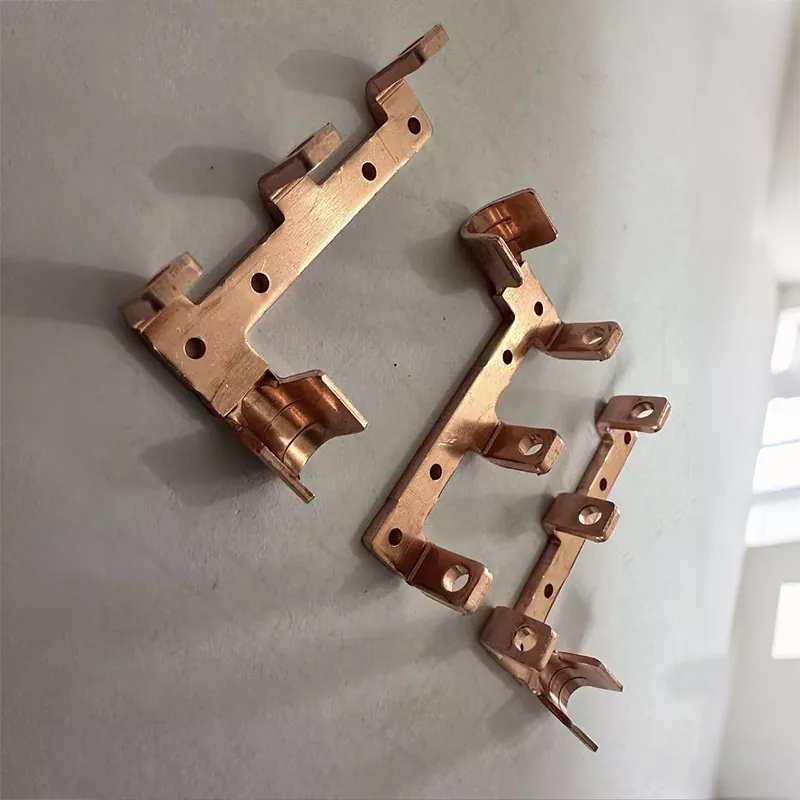
3. Power circuit conduction layout of the ECU main control unit in fuel vehicles
The engine electronic control unit not only receives weak electrical signals from various sensors, but also needs to supply working power to actuators such as fuel injectors, ignition coils, and idle valves. This copper terminal is welded and fixed in two stamping forms (soldering and pin) on the power pads of the ECU circuit board to isolate the power loss during the line transmission process. The engine compartment is always in a high-temperature, oil-stained, and water vapor mixed environment, and the copper plating layer of the terminal can delay the oxidation and rusting of the copper substrate, even if the vehicle undergoes long-term start-stop cycles and body resonance impacts, the connection position between the terminal and the PCB pad is less likely to crack or short-circuit, ensuring the continuous and stable output of the ECU power signal, and avoiding vehicle driving faults such as ignition abnormalities and fuel supply control disorders.
4. Large-power circuit bearing connection of the vehicle start-up system
The instantaneous working current of the starting motor is extremely high. The main control line between the battery and the starting motor, as well as the power contact points of the starting relay, are all equipped with this stamped copper terminal, the driver only needs a weak control current to drive the relay coil to be attracted, and the copper terminal takes over the large power current output by the battery to directly reach the starter, driving the crankshaft to complete the engine ignition start process, the terminal has excellent resistance to current impact, can withstand the current surge during each start-up, and will not have contact surface burnout or carbonization problems in long-term repeated start-stop operations, at the same time, the terminal structure is adapted to the narrow wiring space in the engine compartment, facilitating the neat arrangement and installation of the vehicle's wiring harness.
5. Connection of the stabilized power supply circuit of the on-board generator
During vehicle operation, the generator continuously charges the battery and continuously supplies power to all onboard electrical appliances, the connection points of the generator output terminal and the stabilized rectifier module use stamped copper terminals for line connection, when the vehicle is idling or running at high speed, the output current of the generator fluctuates, the stable conductivity of the terminals can mitigate the heat generation caused by the current fluctuations, the electroplated structure can resist the high-temperature oil corrosion in the cabin, ensuring the smooth operation of the charging system in the vehicle and eliminating problems such as battery depletion and unstable power supply for onboard electrical appliances.